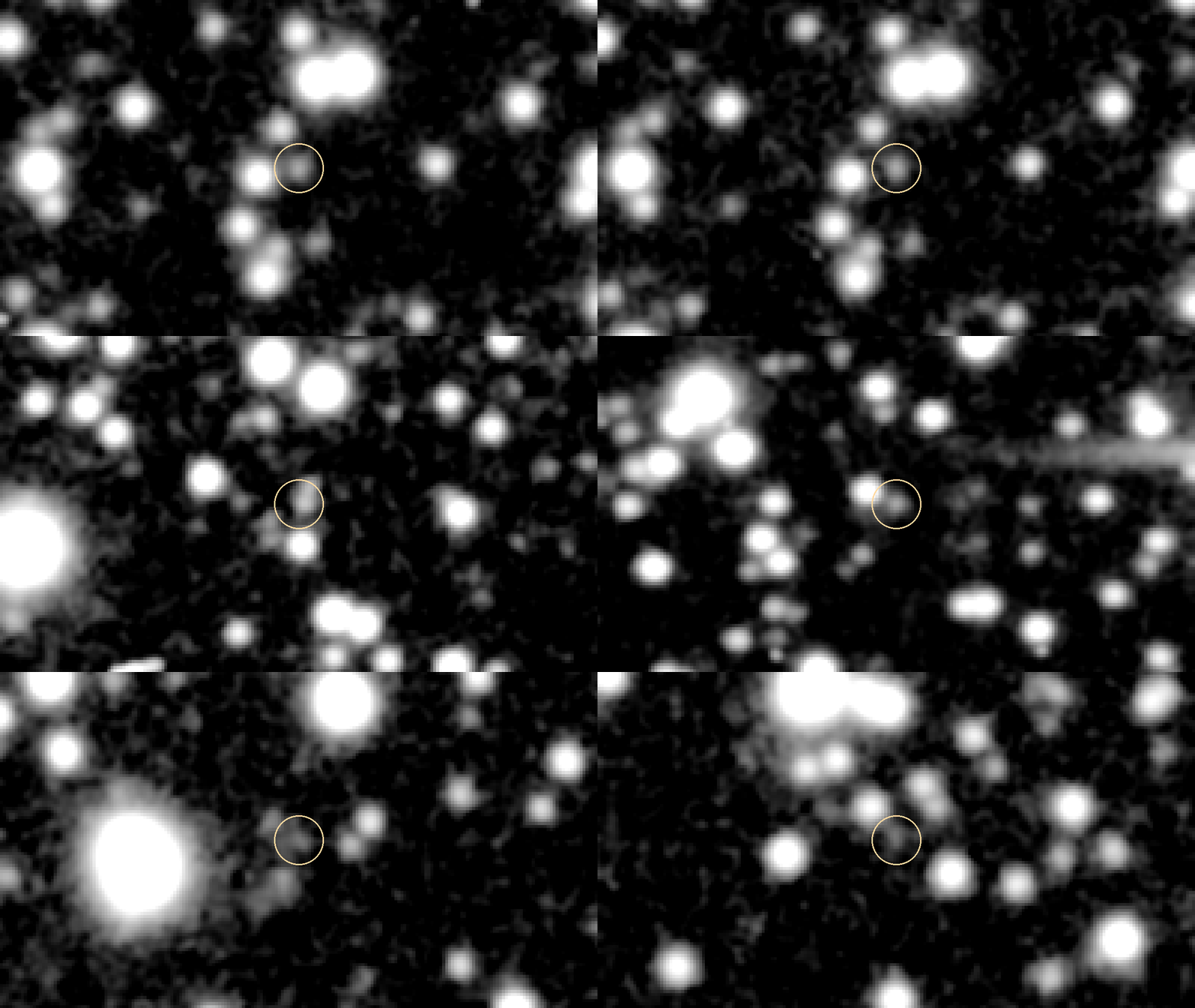
Claude and I found a dwarf planet candidate. It's the ~50th largest known object in our entire solar system. That includes the Sun, planets, and moons. Among minor planets, it ranks ~27th.
The Rubin Observatory is a new observatory in Chile with the largest camera ever built. We found traces of the object in its 2025 data, in a crowded strip of the Milky Way.
For a week, we couldn't find more proof it existed. While the Rubin data was still strong, it was very suspicious that the object didn't appear in any older survey. Then Fable 5.2, a Claude model that released during our analysis, spotted a bug in the orbit code.
With the code fixed, we tested 50 billion orbits against old public telescope images. One hit.
The object was there in 2013, 2014, 2015, 2017, 2018, and 2019 across the Dark Energy Camera and the Canada-France-Hawaii Telescope. It had been sitting in public archives for 12 years.
In all, we found it in 13 archival images from 2013 to 2019. With Rubin’s 2025 sightings, that’s a 12-year track, and one orbit fits every position to within 0.08 arcseconds.
It's ~590 km wide based on best estimates. Using albedos measured from distant bodies beyond Neptune (TNOs) of similar brightness, the likely range is 462 km to 707 km, though the object may reach above 1000 km.
A dwarf planet is in part defined by its ability to pull itself round. While we can't yet be sure of the object's shape, its large size makes this a borderline candidate for dwarf planet status.
The object is currently twice as far out as Pluto, with a rather eccentric orbit (32 to 79 au, tilted 12° to the planets' orbits). It takes 410 Earth years to orbit, and sunlight takes 10.9 hours to reach it.
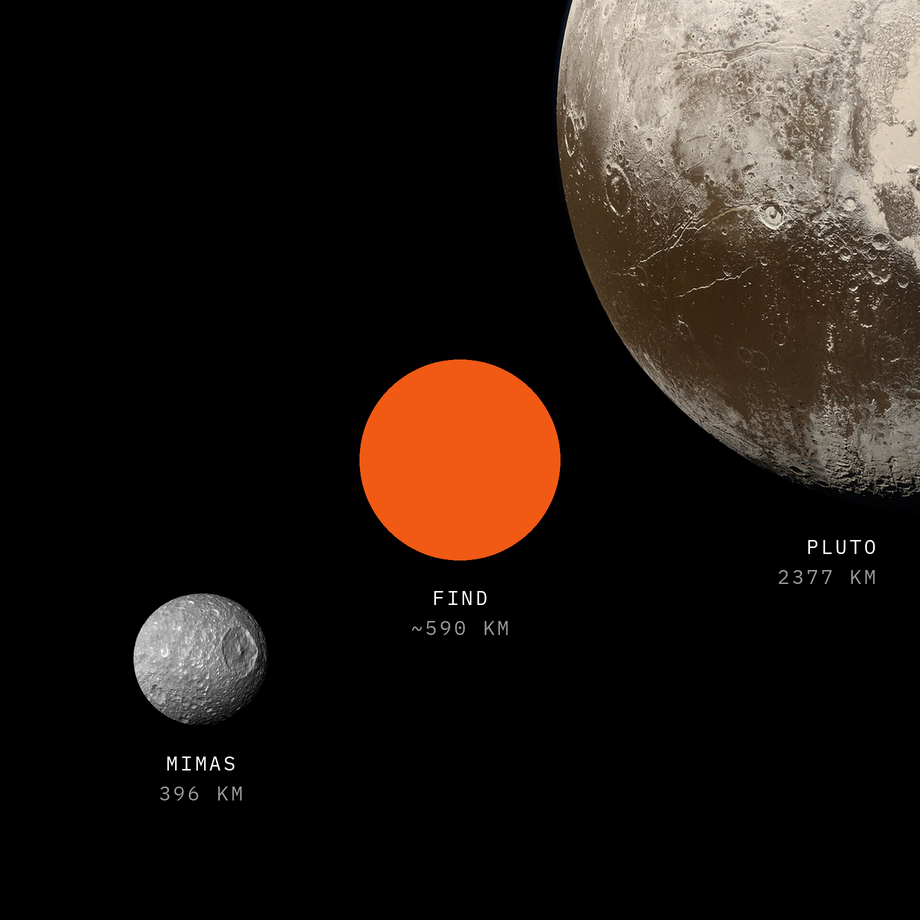
It's filed with the Minor Planet Center and doesn't have a name yet. Our next goal is an official designation, then measurements of its size and shape (a stellar occultation, or ALMA). A search for moons would also help. If it has one, the moon’s orbit would give its mass and density.
This is the first of many exciting astronomy announcements we're making at Macrogrants. Thank you to my collaborators Will DePue and Luke Farritor.
I'm very grateful to astronomer Mario Juric of Rubin's Solar System team for verifying the find, and to University of Washington astronomers Joseph Murtagh and Colin Orion Chandler for further analysis.
More to come soon!
